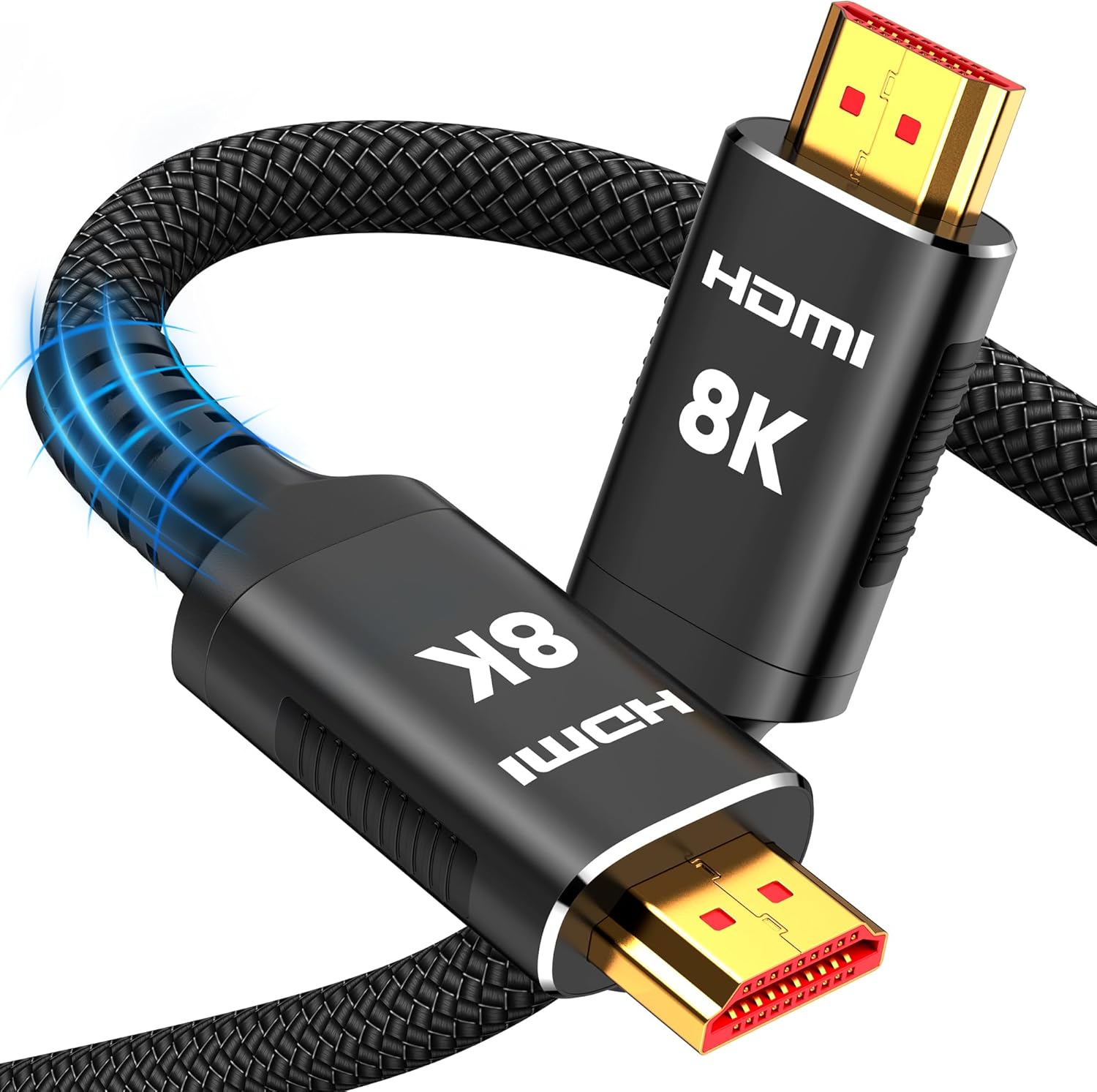
Snowkids Long HDMI Cable 25 ft, 8K 48Gbps Ultra High-Speed HDMI 2.1 Cables Cord, 10K 8K@60Hz, 4K@120Hz Compatible for TV/Laptop/Monitor/PS-5/X-box/Projector/Entertainment, Sound System & More


Price: $23.99
(as of Mar 20, 2026 11:56:43 UTC – Details)

Snowkids Long HDMI Cable 25 ft: A Comprehensive Review of High-End 8K Connectivity
In the ever-evolving landscape of home entertainment and professional setups, the humble HDMI cable has undergone a silent revolution. The push for higher resolutions, faster refresh rates, and immersive audio has birthed a new standard: HDMI 2.1. For those needing to bridge significant distances—spanning living rooms, conference halls, or auditoriums—a long cable that genuinely delivers on these advanced promises is a critical, yet often challenging, component. The Snowkids Long HDMI Cable 25 ft, 8K 48Gbps Ultra High-Speed HDMI 2.1 enters this arena with a bold set of specifications. This review dissects its claims, construction, and real-world applicability based solely on its technical description and provided details, offering a clear-eyed assessment for the discerning buyer.
Unpacking the Core Technology: HDMI 2.1 and 48Gbps Bandwidth
The cornerstone of this cable’s identity is its adherence to the HDMI 2.1 specification. This isn’t merely a incremental update; it’s a paradigm shift in bandwidth capacity. The stated 48Gbps (Gigabits per second) transmission speed is the definitive number for the full, un-compressed potential of the standard. This immense pipeline is what enables the flagship features: 8K resolution at 60Hz and 4K resolution at 120Hz. For context, a standard 4K/60Hz signal uses about 12.54Gbps. The jump to 48Gbps is not just about raw pixel count; it’s the bandwidth required for high dynamic range (HDR) at 48 bit/px color depth, lossless audio formats like Dolby TrueHD 7.1, and the suite of gaming-enhancing features.
The product description explicitly lists compatibility with VRR (Variable Refresh Rate), ALLM (Auto Low Latency Mode), QFT (Quick Frame Transport), and QMS (Quick Media Switching). These are not just buzzwords; they are essential for a smooth, tear-free gaming experience on modern consoles like the PS-5 and Xbox Series X/S. By supporting these, the cable ensures the display’s refresh rate syncs dynamically with the console’s output, eliminating stuttering and judder. The inclusion of eARC (Enhanced Audio Return Channel) is also crucial, allowing for high-bitrate audio from a compatible TV to be sent to a sound system over the same cable, simplifying home theater wiring. The mention of DSC (Display Stream Compression) is notable; while visually lossless, DSC is a compression tech that helps fit extremely high-bandwidth signals (like 8K/120Hz or 4K with HDR and high chroma subsampling) within the 48Gbps limit. This cable is designed to handle the entire HDMI 2.1 feature set as defined by the standard.
The Fiber Optic Advantage: Solving the Long-Run Problem
This is the most critical and unique specification hidden in plain sight. The product Q&A reveals this is a “fiber optical cable” and is unidirectional. This is a radical departure from the traditional copper-based HDMI cables most consumers are familiar with.
- Why Fiber for 25 Feet? For long cable runs beyond 15-20 feet, standard copper HDMI 2.1 cables begin to struggle. The high-frequency signals required for 48Gbps are susceptible to attenuation (signal loss) and electromagnetic interference (EMI) over long distances. A fiber optic cable solves this by converting the electrical signal to light, which travels through glass or plastic fibers with minimal loss and zero susceptibility to EMI. This means a 25-foot run, which would be a major hurdle for a copper cable trying to sustain 8K/60Hz or 4K/120Hz, becomes theoretically trivial. The signal remains strong and clean from source to display, regardless of the electrical noise in the environment.
- The Unidirectional Caveat: The Q&A is starkly clear: “No, this fiber optical cable is unidirectional.” This is the single most important operational detail. You must connect the end labeled “SOURCE” (e.g., PS-5, Blu-ray player, laptop) to the “DISPLAY” end (TV, monitor, projector). Plugging it in backwards will result in no signal. This is a fundamental characteristic of active fiber optic cables—they have built-in electronics at each end to do the electro-optical conversion, and the data path is designed to flow one way. It’s not a flaw, but a necessary design trait for this technology at this length and bandwidth. Users must be mindful of the labeling during installation.
Build Quality and Design: Engineered for Demands
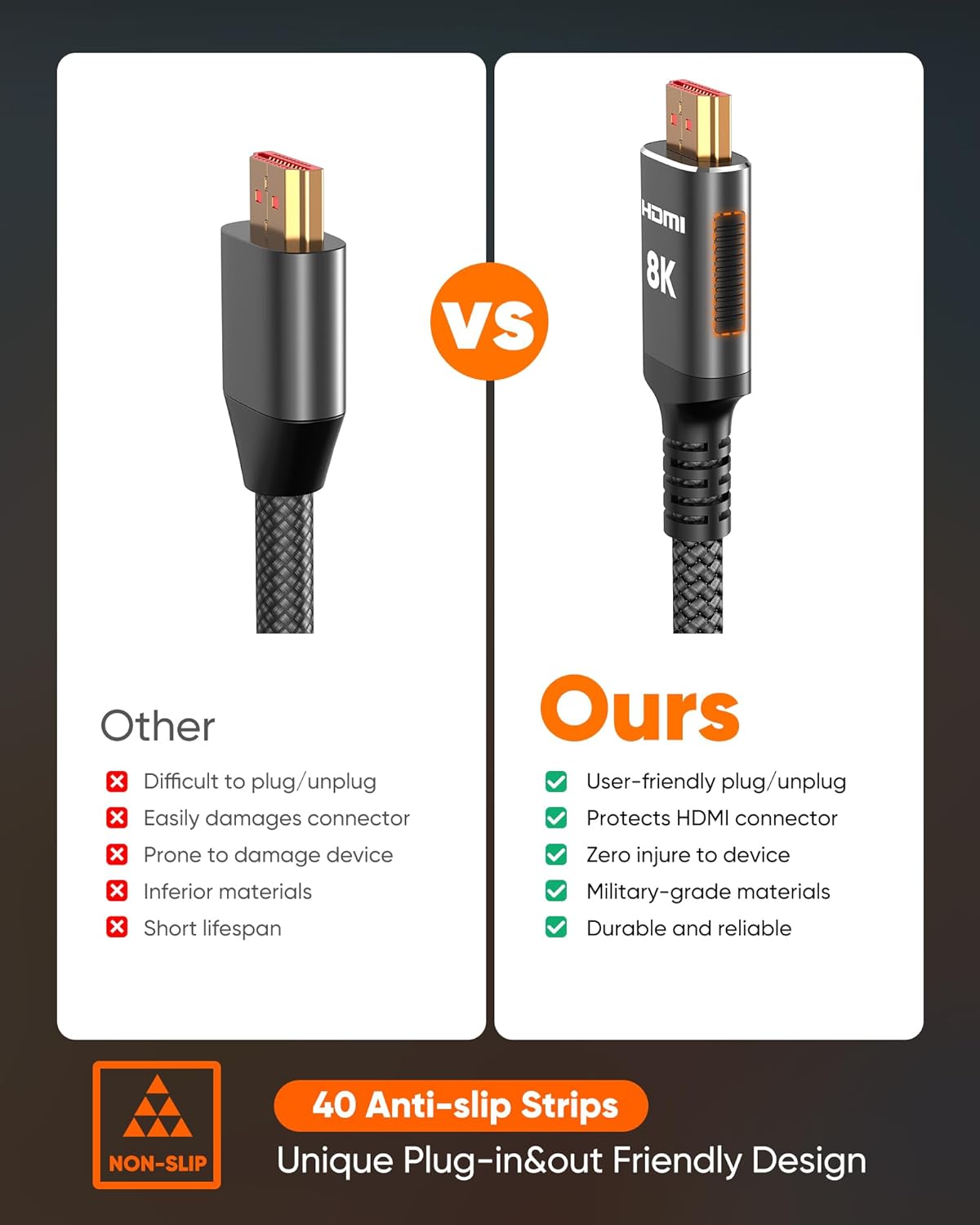
Snowkids emphasizes a “Durable Design” featuring an “SR Flexible Strength Design,” 24K gold-plated ports, and military-grade tensile nylon.”
- The 24K gold plating on the connectors is a standard premium feature, offering superior corrosion resistance and a reliable connection over time, which is especially important for frequently plugged/unplugged setups.
- The mention of “military-grade tensile nylon” suggests a robust braided outer sheath designed to withstand pulling, twisting, and abrasion. The claim of withstanding “25,000 flex times” at the connector joint speaks to a focus on longevity at stress points, a common failure zone for any cable.
- The “SR Flexible Strength Design” appears to be their proprietary term for a reinforced cable jacket or internal strain relief. For a 25-foot run that may be routed behind walls, under carpets, or around corners, flexibility paired with tensile strength is a valuable attribute.
While these descriptors are marketing language, they point to a cable built with more care than a cheap, thin, commodity cable. For a permanent installation or a high-traffic area, this construction should provide peace of mind.
Compatibility and Use Cases: A Universal Candidate?
The description states “Universal Compatibility” for all HDMI devices: HDTVs, monitors, laptops, PS-5, Xbox, projectors, sound systems, and more. Technically, this is accurate. The HDMI 2.1 standard is backward compatible with all previous versions (2.0, 1.4, etc.). You can plug this cable into an older 4K/60Hz TV or a 1080p projector, and it will function perfectly at the highest resolution and refresh rate that both the source and display support.
Ideal Use Cases for this 25ft Fiber Optic HDMI 2.1 Cable:
- Gaming Consoles to Wall-Mounted TVs: Running a PS-5 or Xbox Series X from an entertainment center to a TV on the opposite wall, ensuring 4K/120Hz with VRR and ALLM are fully realized.
- Home Theater PCs (HTPCs) or Laptops to Projectors/Far-Reaching Displays: For presentations, movie nights, or immersive gaming in a dedicated room where the computer is housed away from the screen.
- Commercial AV Setups: Conference rooms, digital signage, or lecture halls where source equipment (PC, media player) is in a rack or closet far from the display.
- Future-Proofing a Long Run: Installing cable in a home during construction or renovation where you want to guarantee support for future 8K sources and displays without needing to re-run conduit.
Critical Considerations: The unidirectional nature makes it less ideal for scenarios where the cable might need to be disconnected and reconnected between different source/display configurations. It’s best suited for a dedicated, permanent, or semi-permanent connection where the source and display roles are fixed.
Quality Control and Value Proposition
The manufacturer states cables undergo “rigorous performance tests in the laboratory before delivery.” For a premium-priced, active fiber optic cable, this is a non-negotiable requirement. These cables contain sensitive optical components and electronic converters. A failure rate out of the box would be unacceptable at this price point. The inclusion of a single 25-foot cable in the box is standard.
Value is subjective. Compared to a short, passive copper cable, this is a significant investment. However, when compared to the cost and hassle of hiring an integrator to install a longer-run, higher-spec solution, or the frustration of a flaky copper cable that drops to a lower resolution, the Snowkids cable offers a compelling DIY value. It provides the performance of a professional-grade long-run solution in a consumer package.
Conclusion: Who is this Cable For?
The Snowkids 25ft Long HDMI 2.1 Fiber Optic Cable is not a generic commodity cable. It is a specialized tool designed for a specific, demanding challenge: delivering the full, uncompromised signal of the HDMI 2.1 standard over a 25-foot distance.
Its strengths are clear:
- Guaranteed 48Gbps bandwidth over 25 feet for 8K/60Hz and 4K/120Hz.
- Immunity to electromagnetic interference thanks to fiber optic construction.
- Support for all key HDMI 2.1 features (VRR, ALLM, eARC, DSC).
- Robust build quality aimed at longevity.
- Truly universal downstream compatibility.
Its limitations are inherent to its design:
- Unidirectional operation requires careful, permanent installation.
- Higher cost than passive copper cables for shorter runs.
- Active cable with electronic components, introducing a (typically small) power draw from the source device and a potential point of failure, though the QC claim mitigates the latter concern.
Final Recommendation: If your setup involves a long cable run (20+ feet) connecting a modern gaming console, high-end GPU, or UHD media player to a capable 4K/120Hz or 8K display, and you demand the absolute highest bandwidth and feature set without signal degradation, this fiber optic cable from Snowkids is a technically sound and practical solution. The investment is justified by the performance it uniquely enables over that distance. For shorter runs under 15 feet, a high-quality passive copper HDMI 2.1 cable is simpler and more versatile. For the long-haul enthusiast, installer, or serious gamer, this cable squarely addresses the problem it sets out to solve.