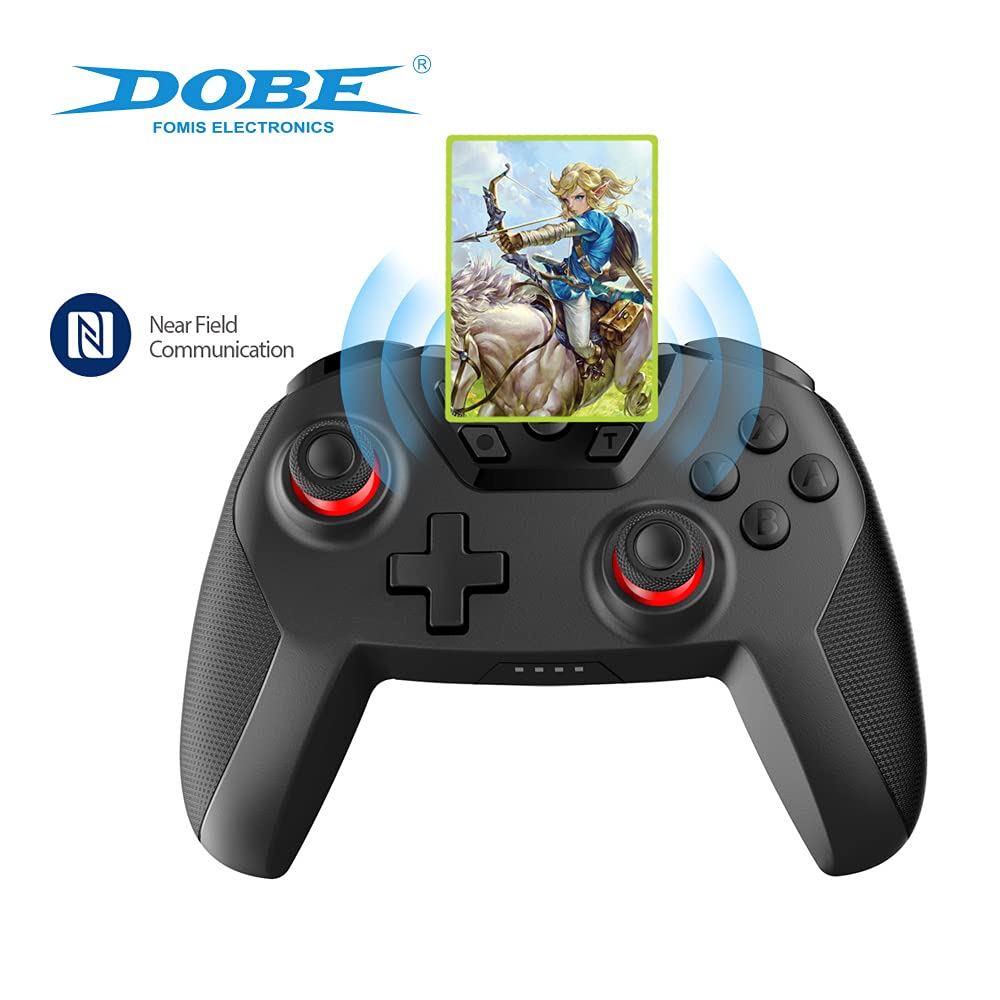
DOBE FOMIS ELECTRONICS TNS-0118A Wireless BT Game Controller For Nintendo Switch Pro Gamepad with NFC Function




Price: $27.19
(as of Mar 20, 2026 10:27:35 UTC – Details)

DOBE FOMIS TNS-0118A Wireless Controller: A Feature-Rich Third-Party Alternative for Nintendo Switch and PC
In the ecosystem of the Nintendo Switch, the official Pro Controller stands as a gold standard for comfort and precision. However, the market for third-party alternatives thrives, offering compelling options that often push beyond the official spec sheet with added functionality and competitive pricing. The DOBE FOMIS TNS-0118A Wireless BT Game Controller enters this space as a direct competitor, promising a robust feature set that includes NFC for Amiibo support, customizable turbo functions, and dual-platform compatibility. This review dissects the TNS-0118A based strictly on its advertised technical specifications and design claims, evaluating its potential value for Switch and PC gamers seeking an alternative.
Design and Ergonomics: A Familiar Silhouette with Practical Touches
At first glance, the TNS-0118A adopts the now-iconic asymmetrical layout popularized by Xbox controllers and embraced by the Switch Pro Controller. This design philosophy places the left analog stick above the D-pad, a configuration favored by many for its ergonomic separation of movement and directional inputs. The description implies a full-sized, comfortable grip suitable for extended play sessions. While exact dimensions and material finishes aren’t specified, the inclusion of features like an adjustable motor vibration speed and a dedicated camera key suggests a thoughtful, gamer-centric design language. The charging indicator light is a standard but useful inclusion, providing clear visual feedback on the controller’s power status without requiring you to look at the console screen.
Connectivity: Truly Wireless Flexibility
The controller’s connectivity suite is its strongest advertised selling point. It supports Bluetooth wireless connection directly to the Nintendo Switch, eliminating the need for the console’s first-party wireless adapter for this specific controller. Furthermore, it offers wired connectivity via USB-C cable to both the Switch and to a Windows PC. This dual-platform wired support is a significant advantage for users who want a single controller for both systems, especially for PC gaming where a wired connection guarantees zero input latency—a critical factor for competitive titles. The description also mentions a “host wake up function” activated via a “code key connection.” This likely refers to a specific button combination (the “code key”) that can power on a sleeping Switch from the controller, mirroring a convenient feature of the official Pro Controller.
Core Feature: NFC and Amiibo Compatibility
The explicit mention of NFC sensing confirms that the TNS-0118A can read Nintendo’s Amiibo figurines. This is not a trivial feature; it unlocks a vast layer of gameplay in dozens of Switch titles, from scanning in new characters and items in The Legend of Zelda: Breath of the Wild and Animal Crossing: New Horizons to tapping figures in Super Smash Bros. Ultimate. For any player invested in games that leverage Amiibo, this functionality is non-negotiable. The controller’s ability to perform this task reliably is a key benchmark for its viability as a primary controller.
Advanced Gameplay Features: Turbo and Motion Controls
The TNS-0118A distinguishes itself with a Turbo (or auto-fire) setting function. This allows players to assign a rapid-fire function to any face button (A, B, X, Y), which can be a boon in certain arcade-style, shooter, or fighting games. A notable upgrade over many basic third-party controllers is the ability to change the Turbo speed, offering customization rather than a single, fixed rate. This level of control caters to players who want to fine-tune this assistive feature to their preference or the demands of a specific game.
Further enhancing its versatility, the controller includes gyroscope gravity induction, meaning it supports motion controls. This is essential for games like Splatoon 2/3 for aiming, Mario Kart 8 Deluxe for steering, or any title that requires tilt-based inputs. The inclusion of a dedicated camera key suggests a shortcut for in-game screenshot or video capture functions, a common feature on the official Pro Controller that improves the user experience.
Haptic Feedback: Adjustable Dual-Motor Vibration
The specification of “asymmetric double motor vibration” indicates two distinct vibration motors, likely placed to provide varied feedback (e.g., rumbling on one side for engine effects, the other for impacts), which is superior to a single, simple rumble. More impressively, the “adjustable motor vibration speed” is a feature typically absent from the official Pro Controller, which has a fixed vibration intensity. This allows users to tailor the strength of the haptic feedback to their liking or to conserve battery by reducing vibration in games where it’s less critical. The quality and crispness of this vibration, while not testable here, is a critical software and hardware integration point that will define the controller’s “premium” feel.
Power and Charging: Standard Specs with Clear Indicators
The controller charges via the ubiquitous USB-C port. The listed input of DC 5.0V / 1.5A is standard for modern controllers and compatible with most phone chargers, power banks, and the Switch dock’s USB ports. The charging indicator light mentioned earlier serves as the primary power management UI. While battery capacity in mAh isn’t provided, the 1.5A input suggests it’s designed for reasonably quick charging. The “Power Save” function is referenced, implying the controller has an auto-off or sleep mode to conserve energy when idle, a necessary feature for any wireless device.
Compatibility and Limitations: A Calculated Choice
The TNS-0118A is explicitly designed for the Nintendo Switch ecosystem and Windows PCs. Its compatibility is not advertised for other consoles (PlayStation, Xbox) or mobile devices, which is a reasonable limitation. Crucially, as a third-party product, it is not officially licensed by Nintendo. This means:
- No Guarantee of Future Compatibility: While it works with current Switch firmware, a future major system update could theoretically break its connection without a manufacturer firmware update, which is not guaranteed.
- Potential for Minor Quirks: Features like motion control calibration or NFC read speed might not be as seamless or consistent as Nintendo’s official hardware, though the description asserts full functionality.
- No Access to Official Accessories: It will not fit into charging grips or docks designed specifically for the Pro Controller’s exact shape.
Positioning and Verdict
The DOBE FOMIS TNS-0118A presents itself as a highly functional, feature-packed alternative to the Nintendo Switch Pro Controller. Its core value proposition lies in offering the essential official features—Bluetooth connectivity, NFC for Amiibo, motion controls—while augmenting them with gamer-requested additions like adjustable turbo speed, customizable vibration intensity, and guaranteed PC compatibility via a wired connection.
For a Switch owner who primarily plays on the console but occasionally dabbles in PC gaming, the TNS-0118A could serve as a competent, all-in-one solution. The adjustable vibration and turbo are tangible upgrades on paper. However, the decision rests on a risk-reward analysis. You gain extra features and potentially a lower price point, but you forgo the guaranteed, seamless integration, build quality assurance, and long-term support that comes with Nintendo’s first-party product. The absence of a listed price in the description makes a direct value comparison impossible, but if the TNS-0118A is significantly cheaper, its feature superiority might justify the trade-off for budget-conscious or feature-focused gamers. If it approaches the cost of the official controller, the value diminishes, and the peace of mind offered by official licensing becomes the more prudent choice.
Ultimately, the DOBE FOMIS TNS-0118A is a compelling specification sheet. It targets a specific niche: the informed Switch/PC gamer who prioritizes specific enhanced features over absolute brand loyalty and is willing to accept the minor uncertainties of the third-party path. Its success will depend entirely on the real-world implementation of its advertised functions—particularly NFC reliability, vibration quality, and latency—which can only be confirmed through hands-on testing. Based solely on its claims, it is a seriously specced contender that demands consideration, but not blind trust.