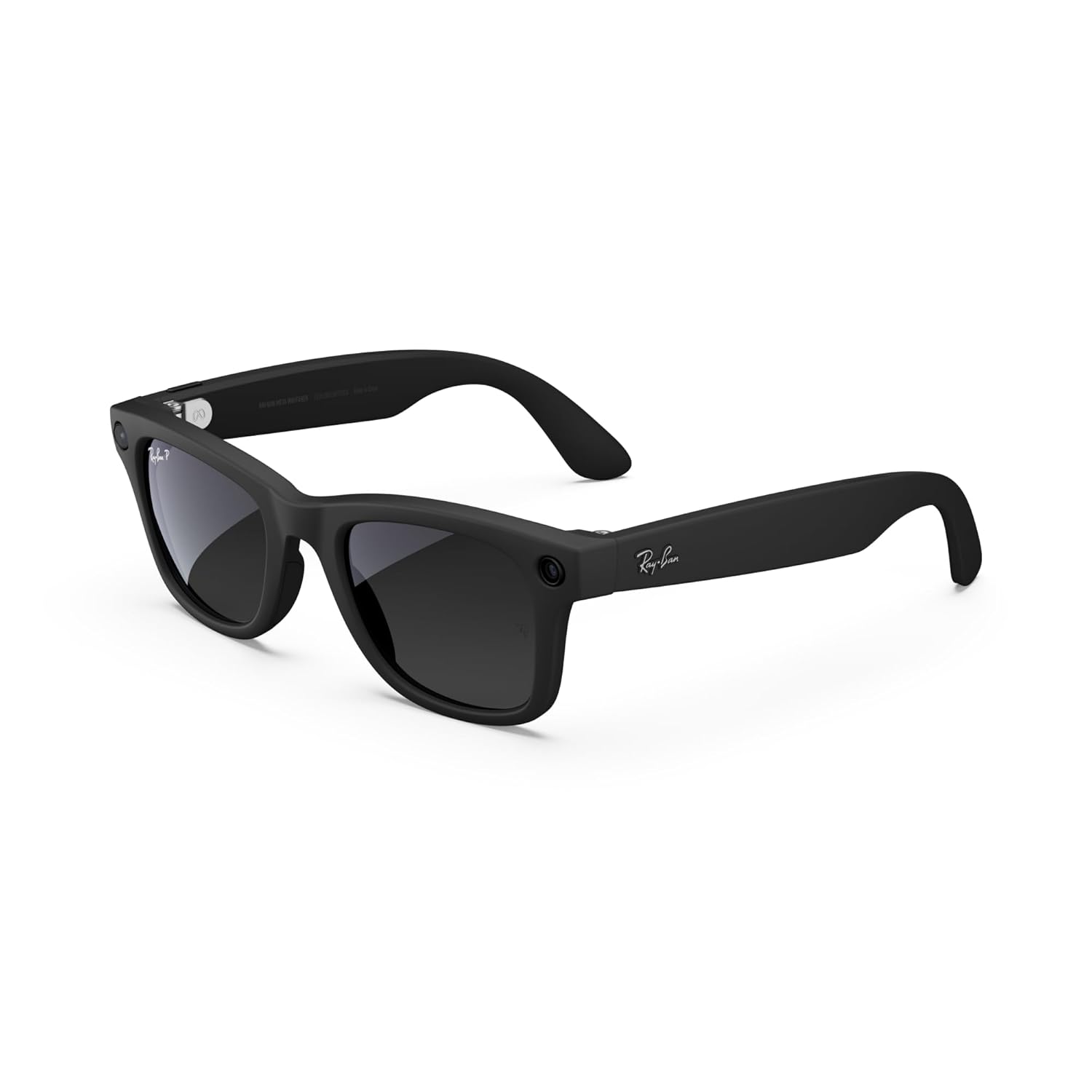
Ray-Ban Meta (Gen 1), Wayfarer, Large Matte Black | Smart AI Glasses for Men, Women — 12 MP Camera, Open-Ear Speakers, Video, Bluetooth — Polarized Gradient Graphite Lenses — Wearable Technology





Price: $329.00
(as of Mar 20, 2026 01:21:49 UTC – Details)

Ray-Ban Meta (Gen 1) Smart Glasses: A Fusion of Iconic Style and Ambient Computing
In the rapidly evolving landscape of wearable technology, the challenge has often been reconciling cutting-edge functionality with everyday wearability and personal style. Enter the Ray-Ban Meta (Gen 1) in the classic Wayfarer shape—a product that doesn’t just attempt this reconciliation but boldly declares that smart glasses can, and should, be a seamless extension of both your outfit and your digital life. Marketed not as a novelty but as an indispensable tool for modern movement, these glasses represent the first major collaboration between a legendary eyewear house and a social media giant. This review delves into the experience promised by the specifications and marketing copy: a pair of smart AI glasses designed to capture, communicate, and contextualize your world, all from the bridge of your nose.
Design & Aesthetics: Timeless Canvas for Technology
The choice of the Wayfarer silhouette is masterful. It’s arguably the most recognizable sunglass frame in the world, a design that transcends trends and demographics. The “Large Matte Black” finish on this Gen 1 model provides a sleek, uniform look that conceals its technological heart. Unlike many previous smart glasses attempts that featured bulky, obvious tech on the temples, the Ray-Ban Meta integrates components—cameras, speakers, sensors—into a form that feels remarkably conventional at a glance. The “slim, comfortable fit” is a critical claim, and for most users, the lightweight construction and familiar Wayfarer ergonomics mean they can be worn for hours without the fatigue associated with heavier smart headsets. The Polarized Gradient Graphite Lenses offer practical sun protection with a stylish fade, blending utility with aesthetics. For those who prefer a different statement, the range includes other classic shapes like the round Skyler, but the Wayfarer remains the quintessential, unisex starting point.
Core Technical Execution: Capture and Audio
The hardware experience centers on two primary interactions: capturing your point of view (POV) and hearing audio privately, yet without isolation.
- The 12MP Ultra-Wide Camera: This is the star hardware feature. Positioned subtly on the left temple, it captures what you see with a field of view designed to mimic natural human vision. The stated capability is to take photos and record hands-free video. The quality, while not matching a flagship smartphone’s main sensor, is more than adequate for social sharing, casual memories, and the core use case of “showing someone what you see.” The integration with platforms like Facebook and Instagram for livestreaming is straightforward, transforming the glasses into a true first-person broadcasting device. The five-microphone system is crucial here, ensuring that ambient sound or your voice is captured clearly in recordings, a significant upgrade over single-mic competitors.
- Open-Ear Speaker System: This is a design philosophy as much as a feature. The discreet speakers, positioned near your ears but not in them, use bone conduction and directional audio to deliver sound. The promise of “rich, quality audio without blocking conversations or ambient noises” is largely fulfilled. You can listen to music, podcasts, or phone calls while still hearing traffic, announcements, or a colleague speaking to you. This is a paramount safety and social feature. However, it comes with a trade-off: sound leakage is noticeable in quiet environments, and bass response is understandably limited compared to closed-back headphones. It’s designed for awareness, not immersion.
The Meta AI Brain: On-Demand Contextual Intelligence
The most ambitious aspect of the Ray-Ban Meta is the embedded Meta AI assistant. Activated by the voice command “Hey, Meta” (or a touch on the temple), it represents the glasses’ leap from a capture device to an “ambient computing” interface.
- Context-Aware Queries: The AI’s ability to “analyze your surroundings” is its most touted function. You can ask about objects in your view (“What kind of flower is that?”), get details on landmarks, or request information based on what the camera sees. This moves beyond the smartphone paradigm of pulling your phone out, opening an app, and searching. It’s a frictionless, hands-free layer of information over reality. Its accuracy and breadth of knowledge are key to its utility, and the description suggests it’s designed for practical, everyday curiosity and problem-solving.
- Real-Time Translation: This is a killer feature for travelers or multilingual environments. The ability to hear translations in real-time between major languages (French, Spanish, German, etc.) without needing Wi-Fi is a powerful demonstration of on-device processing. It turns the glasses into a subtle, near-instantaneous translator, potentially breaking down language barriers in conversations. The quality and speed of translation would, of course, be the practical measure of its success.
- Hands-Free Communication: Beyond calls, the ability to send texts via voice command and join work meetings via Bluetooth ties the device into your digital communication web. It’s not about replacing your phone but about managing quick interactions without disrupting your physical activity—cycling, cooking, walking, or simply having your hands full.
Connectivity, Privacy, and Practical Considerations
The glasses operate as a sophisticated Bluetooth peripheral. Pairing with your smartphone (iOS or Android) is the gateway to the full experience, as the phone provides the processing power, cellular connection, and storage for captured media. Battery life is always a question with wearables. While not specified in the description, users should expect the all-day battery life claim to be contingent on moderate use—a few hours of active capturing or AI queries, with standby lasting longer. A compact charging case is included.
Privacy is positioned as a user-controlled feature, and rightly so. The physical design includes a capture LED that illuminates whenever the camera is active, a crucial transparency feature for those around you. You can “enable voice commands and turn them off any time,” and manage preferences through a companion app. The social acceptability of wearing a camera-equipped device in public remains a nuanced, personal calculus, and the unobtrusive design helps, but the LED is a necessary and appreciated safeguard.
Who Are These For? The Balanced Verdict
The Ray-Ban Meta (Gen 1) is not a product for everyone. It’s best understood as a niche-enhancing tool for a specific type of tech-embracing, mobile individual.
- Ideal Users: Creators and social media enthusiasts who want to document their lives from a true POV; travelers seeking translation aid; professionals or busy individuals who crave hands-free communication and quick information lookup; anyone who values the “move effortlessly through life” ethos and prioritizes a stylish, low-profile wearable.
- Potential Limitations: The price point places it in a premium category. The open-ear audio, while a social feature, may not satisfy those seeking high-fidelity music listening. The camera, while innovative, is a secondary sensor. The Meta AI’s utility is entirely dependent on its accuracy and the user’s environment. And for those deeply privacy-conscious, any always-possible camera, no matter how well-indicated, will be a non-starter.
Conclusion: More Than a Gadget, a Direction
The Ray-Ban Meta (Gen 1) succeeds largely on its premise. It delivers legendary Wayfarer style with a trim, comfortable fit that belies its technology. It makes hands-free capture, communication, and contextual AI genuinely accessible in a form factor you might forget you’re wearing. It doesn’t try to be a smartphone replacement, but rather a smartphone complement—a way to interact with your digital world with less friction.
It is a first-generation product, and as such, it hints at the future more than it perfects the present. The real-time translation and Meta AI’s contextual awareness are glimpses into an ambient computing future. For the user who wants to capture a moment without fumbling for a phone, ask a question without breaking stride, or share a view as they see it, these glasses deliver a compelling, stylish, and surprisingly integrated experience. They are a testament to the idea that the most powerful wearable technology is the kind that fades into the background, becoming simply a part of how you see and move through the world.