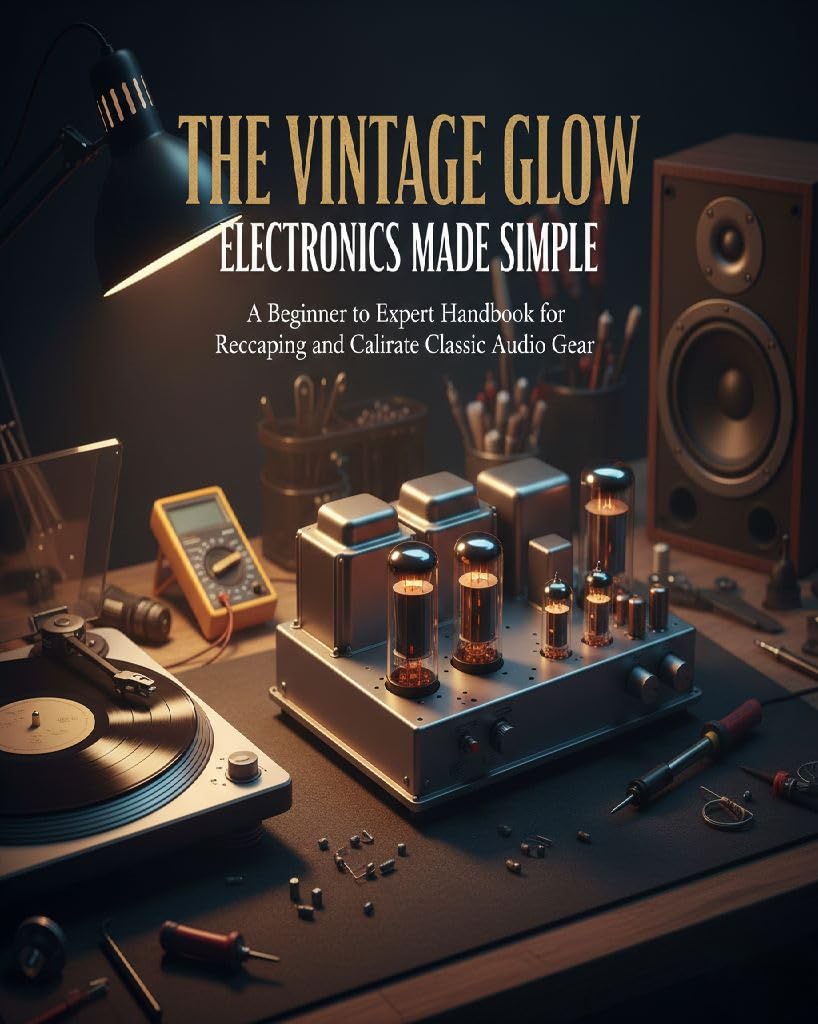
Electronics Workshop Companion for Hobbyists
Price: $27.90 - $14.87
(as of Jan 06, 2026 01:24:36 UTC – Details)
Electronics Workshop Companion for Hobbyists is a comprehensive guide designed to help hobbyists and enthusiasts set up their own home electronics workshop. Written by electronics expert Stan Gibilisco, this book is a step-by-step resource that covers everything from constructing a workbench to stocking it with the necessary tools, components, and test equipment.
The book begins by providing tips and techniques for building a functional and efficient workbench, which is the foundation of any electronics workshop. Gibilisco covers the essential tools and equipment required, including soldering irons, wire strippers, and multimeters. He also provides guidance on how to organize the workspace to maximize productivity and minimize clutter.
Once the workbench is set up, the book delves into the world of electronic components, including resistors, capacitors, inductors, transformers, diodes, transistors, and integrated circuits. Gibilisco explains the principles and characteristics of each component, providing clear illustrations and diagrams to help readers understand the concepts.
One of the strengths of this book is its hands-on approach. Throughout the chapters, Gibilisco includes interesting do-it-yourself experiments and projects that allow readers to put their knowledge into practice. These experiments are designed to help readers develop a deeper understanding of electronic circuits and gadgets, and to encourage them to think creatively and develop their own projects.
The book also covers various techniques, calculations, and formulas that are essential for working with electronic components. Gibilisco provides detailed explanations of concepts such as Ohm’s law, Kirchhoff’s laws, and the fundamentals of circuit analysis. He also covers more advanced topics, such as circuit design, simulation, and testing.
Throughout the book, Gibilisco emphasizes the importance of safety and proper laboratory practices. He provides guidance on how to handle sensitive equipment, how to avoid electrical shock, and how to dispose of electronic waste properly.
The book is divided into sections that cover specific topics, making it easy for readers to navigate and find the information they need. The chapters are well-organized, and the language is clear and concise, making it accessible to readers with varying levels of experience.
The inclusion of clear illustrations and diagrams is another notable feature of this book. The illustrations help to clarify complex concepts and make it easier for readers to understand the material. The diagrams also provide a visual representation of the electronic components and circuits, making it easier for readers to identify and connect the components.
In terms of content, the book covers a wide range of topics, including:
* Resistors: Gibilisco explains the different types of resistors, including fixed and variable resistors, and provides guidance on how to select and use them in circuits.
* Capacitors: He covers the different types of capacitors, including ceramic, electrolytic, and film capacitors, and explains how to use them in filtering, coupling, and bypassing applications.
* Inductors: Gibilisco explains the principles of inductance and provides guidance on how to use inductors in filtering, tuning, and impedance-matching applications.
* Transformers: He covers the different types of transformers, including step-up and step-down transformers, and explains how to use them in power supplies, audio equipment, and other applications.
* Diodes: Gibilisco explains the principles of diode operation and provides guidance on how to use diodes in rectification, regulation, and switching applications.
* Transistors: He covers the different types of transistors, including bipolar and field-effect transistors, and explains how to use them in amplification, switching, and logic applications.
* Integrated circuits: Gibilisco explains the principles of integrated circuit operation and provides guidance on how to use integrated circuits in digital and analog applications.
Overall, Electronics Workshop Companion for Hobbyists is a comprehensive and practical guide that provides hobbyists and enthusiasts with the knowledge and skills needed to set up and operate a home electronics workshop. The book is well-organized, clearly written, and provides a wealth of information on electronic components, circuits, and techniques. Whether you are a beginner or an experienced electronics enthusiast, this book is an excellent resource that will help you to develop your skills and take your electronics projects to the next level.
The book’s publisher, McGraw Hill TAB, is a well-respected publisher of technical books, and the quality of the publication is evident in the book’s layout, formatting, and content. The book is available in digital format, with a file size of 16.9 MB, and is compatible with screen readers. The print length is 411 pages, and the book is part of the Electronics series.
In conclusion, Electronics Workshop Companion for Hobbyists is an excellent resource for anyone interested in setting up a home electronics workshop. The book provides a comprehensive guide to electronic components, circuits, and techniques, and is written in a clear and concise manner. With its practical approach and emphasis on safety and proper laboratory practices, this book is an essential resource for hobbyists and enthusiasts of all levels.