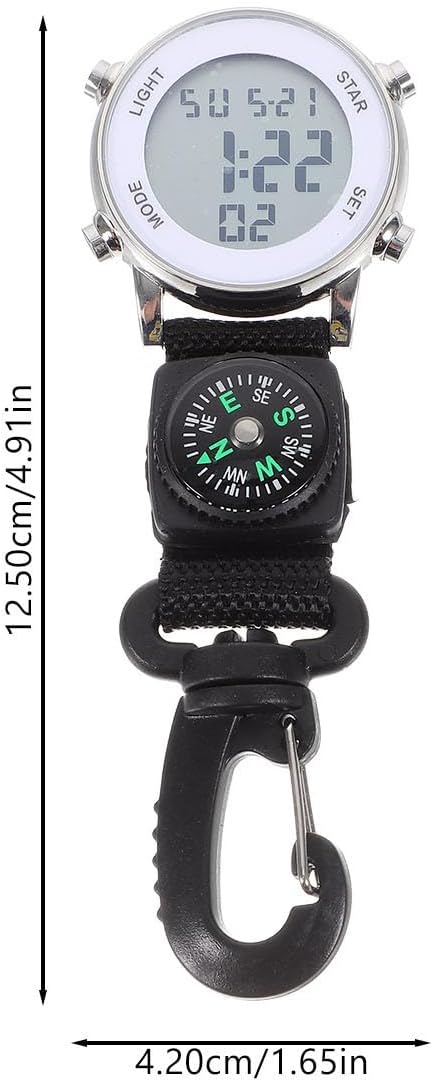
Mikikit Digital Pocket Watch, Clip On Watch Quartz Portable Hanging Buckle Backpack Fob for Climbing Hiking Outdoor Sports




Price:
(as of Mar 20, 2026 10:46:30 UTC – Details)

The Mikikit Digital Pocket Watch: A Minimalist Timekeeper for the On-the-Go Lifestyle
In an era dominated by smartwatches and smartphone notifications, there remains a compelling niche for simple, dedicated devices that perform a single task with quiet efficiency. The Mikikit Digital Pocket Watch, with its clip-on, portable design, enters this space targeting outdoor enthusiasts, travelers, and professionals who need accessible timekeeping without distraction. Based solely on its provided specifications and design claims, this review examines whether this small, utilitarian gadget delivers on its promise of durable, accurate timekeeping for a versatile range of activities.
Design and Build: Lightweight and Unassuming
The first notable characteristic of the Mikikit watch is its extreme portability. With package dimensions of just 4.69 x 1.69 x 0.59 inches and a weight of a mere 1.45 ounces, it is virtually feather-light. This is achieved through a combination of materials: a nylon strap/housing, a glass display cover, and a zinc alloy clip and buckle mechanism.
The clip-on design is the watch’s defining feature. It transforms the timepiece from a traditional pocket watch into a versatile “fob” that can be attached to a backpack’s D-ring, a belt loop, a carabiner, the strap of a hiking pole, or even the pocket of a work uniform. This hands-free accessibility is its core utility. For a hiker with gloves on, a climber with a loaded harness, or a nurse in a fast-paced hospital, the ability to glance at the time without fumbling for a wrist or a pocket is a genuine ergonomic advantage.
The material choice suggests a focus on cost-effective durability. Nylon is weather-resistant and won’t rust, making it suitable for sweat, light rain, or the occasional splash—critical for hiking and climbing. The zinc alloy clip must be robust enough to secure the watch through rigorous movement, and the description’s claim of “high grade materials, durable and safe to use, will not easily be scratched” points to ascratch-resistant glass surface. However, the emphasis on “not easily” acknowledges that it is not scratch-proof; hard impacts against abrasive rock or concrete could still mar the glass. The zinc alloy, while lightweight, may be susceptible to corrosion if repeatedly exposed to saltwater or harsh chemicals without rinsing, a consideration for marine or industrial environments.
Functionality: Quartz Precision and Digital Clarity
At its heart, this is a quartz digital watch. Quartz movements are renowned for their accuracy and reliability, a significant advantage over mechanical movements in fluctuating temperatures and altitudes common in outdoor sports. The product description explicitly states it “provides precise and accurate time keeping, suitable for long time use,” which is the fundamental promise of any quartz timepiece.
The digital display offers immediate readability. There is no need to decipher analog hands in poor light; the numerals are clear and unambiguous. This is a major benefit for quick glances during a mountaineering scramble or while running. The included button battery eliminates the initial hassle of sourcing a power source, and quartz batteries typically last years, aligning with the “long time use” claim.
The functions beyond timekeeping are not detailed in the description, leaving some ambiguity. It is presumed to show hours and minutes, and possibly a date window. The absence of mention for alarms, chronographs, timers, or backlighting suggests a stripped-down design. For an ultra-lightweight minimalist, this lack of “features” is a benefit—there are no complicated menus to navigate. But for a user needing interval timing for workouts or navigation, its simplicity becomes a limitation.
Target Use Cases: Versatility in Attachment
The marketing effectively outlines its intended scenarios:
- Outdoor Sports (Hiking, Climbing, Camping, Running): Here, the clip-on style excels. Attaching it to a backpack strap ensures it’s always visible. Its light weight adds negligible burden to an ultralight pack. The durability claims must hold up against scrapes, drops, and exposure. The waterproof rating (not specified) is the biggest unknown for these activities—while “water-resistant” is likely, “waterproof” is a higher bar.
- Travel: As a travel watch, its low profile and lack of expensive materials make it a low-risk, high-utility item. It can be clipped to a daypack, a luggage handle, or a belt, providing constant time access without the fear of loss or theft that comes with a high-value timepiece.
- Professional/Indoor Use (Hospital, School, Supermarket): This is an insightful application. In roles where hands are frequently full or gloved, and a wristwatch might be contaminated (healthcare) or interfere with equipment (some lab settings), a clipped-on watch on a uniform or lanyard is a sanitary and practical solution. Its unobtrusive digital face is easy to read at a glance during a busy shift.
Analysis of Strengths and Potential Weaknesses
Strengths:
- Accessibility: The clip-on system is its greatest asset, enabling placement where a wristwatch cannot go.
- Simplicity and Reliability: Quartz digital timekeeping is fundamentally reliable. No charging, no software glitches, minimal user error.
- Ultra-Lightweight & Compact: It will be forgotten until needed, a prime trait for weight-conscious adventurers.
- Cost-Effective: Based on the materials, it is positioned as an affordable tool, not an heirloom.
- Universal Design: The “unisex-adult” department and simple aesthetic make it suitable for nearly any user or uniform.
Potential Weaknesses / Considerations:
- Display Legibility: The description does not specify display type (LCD, LED) or contrast. In direct, bright sunlight, some digital displays can wash out—a potential issue for alpine climbing or desert trekking.
- Clip Security: The long-term integrity of the zinc alloy clip and its attachment point to the nylon is the single most critical durability question. A failed clip while on a rock face or in deep woods would mean losing the watch.
- Lack of Advanced Features: For anyone wanting heart rate, GPS, altitudes, or notifications, this is the opposite of what they need. It is a replacement for a phone/wristwatch for time only, not a supplement.
- Weatherproofing Gaps: No explicit IP (Ingress Protection) rating is given. “Durable” does not guarantee submersion resistance. For serious whitewater kayaking or diving, it is unsuitable.
- Aesthetic: Its purely utilitarian look may not appeal to those who view a watch as a fashion accessory.
Conclusion: A Niche Tool That Excels at Its Core Task
The Mikikit Digital Pocket Watch is not trying to be a smartwatch or a luxury accessory. It is a focused, functional tool designed for one primary purpose: providing reliable, hands-free time access in environments where traditional watches are impractical. Its success hinges entirely on the durability of its clip mechanism and the legibility of its display in challenging conditions.
Based on the provided information, it appears to be a well-conceived solution for its target audience—the hiker clipping it to a pack strap, the clinician attaching it to a scrub pocket, the traveler latching it to a carry-on. The quartz movement guarantees accuracy, the materials promise reasonable weather and scratch resistance, and the design maximizes convenience.
For the right user, this is a brilliant piece of kit. It embodies the “just works” philosophy. If your priority is seeing the time without interrupting your activity, and you value simplicity and weight above all else, the Mikikit watch fills a specific and useful gap in the market. However, if your activities demand robust waterproofing, extreme durability certifications, or connected features, this minimalist device will not meet those needs. Its value is entirely measured by how effectively it solves the simple problem of accessible timekeeping in your specific routine.