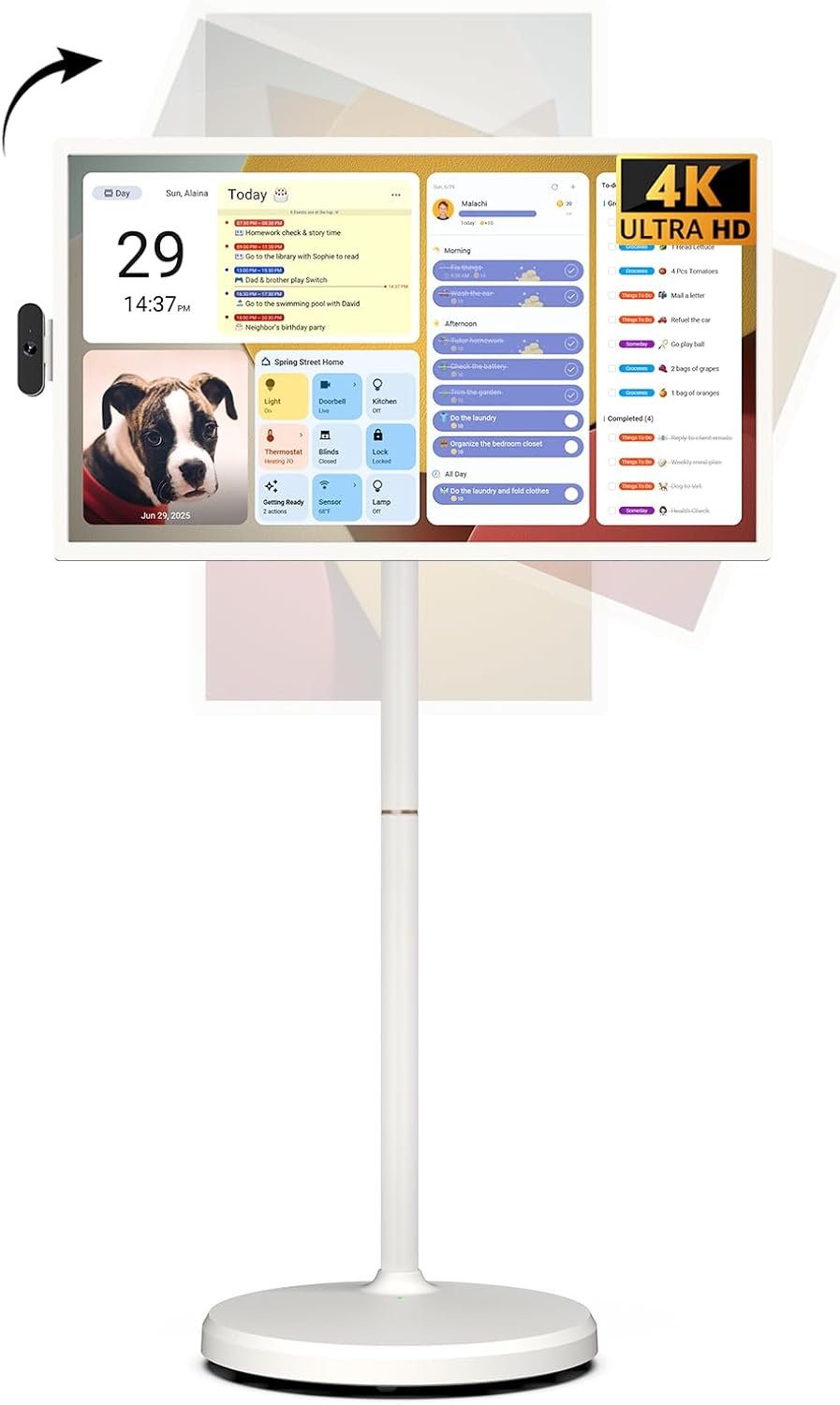
ApoloSign 32” UHD 4K Smart Portable TV 2nd Gen, 16(8+8) GB RAM+256GB, Android 16, EDLA-Certified, Portable Touch Screen Monitor, Built-in 15000mAh Battery, Full Swivel Rotation, Voice Remote Control


Price:
(as of Mar 20, 2026 10:20:02 UTC – Details)

ApoloSign 2nd Gen 32” Smart Portable TV: A Comprehensive Review of a Versatile Mobile Entertainment Hub
In an era where mobility and flexibility define our digital consumption, the concept of a truly portable, high-performance smart display has moved from fantasy to necessity. The ApoloSign 32” UHD 4K Smart Portable TV 2nd Gen enters this burgeoning market not as a mere gadget, but as a bold statement of what an all-in-one mobile screen can be. Combining a substantial 32-inch 4K touch interface with robust Android intelligence and exceptional physical freedom, it targets a wide demographic from on-the-go professionals to families seeking flexible home entertainment. This review dissects the device based solely on its advertised specifications and claimed features, evaluating its potential impact and practical utility.
Unboxing the Promise: Core Specifications and First Impressions
The headline specifications are immediately compelling: a 32-inch 3840×2160 (4K UHD) touchscreen supporting ten-point touch, powered by Android 16 OS with Google EDLA certification. The hardware foundation includes a substantial 16GB of RAM (configured as 8GB + 8GB) and 256GB of internal storage. Powering this package is a large 15,000mAh built-in battery, with the manufacturer claiming up to 8 hours of runtime. Physically, it’s mounted on a mobile base with five silent universal wheels and features a “full swivel rotation” mechanism for vertical and horizontal adjustment. Connectivity is handled via HDMI and USB ports, and it includes an 8MP HD camera and a voice remote control.
The design philosophy is clear: no妥协ing on screen size for portability. Unlike smaller tablet-first portable monitors, this is a genuine television-sized display engineered for movement. The inclusion of a robust stand with wheels and articulation suggests it’s designed to be a semi-permanent room fixture that can also be relocated with minimal effort.
Display Quality: 4K Clarity with Touch Interaction
The 4K resolution on a 32-inch panel promises a pixel-dense, sharp image ideal for everything from spreadsheet work to cinematic movie nights. The ten-point touch capability transforms it from a passive screen to an interactive workstation or gaming surface. For creative applications, digital art, or collaborative presentations, this level of touch responsiveness is a critical feature. The description emphasizes that the display “brings a UHD visual experience and makes your content come alive,” suggesting a focus on vibrant color reproduction and clarity suitable for media consumption. While we cannot assess color accuracy or peak brightness without hands-on testing, the specification targets the premium end of the portable display spectrum.
Software and Performance: Android 16 and EDLA Certification
The choice of Android 16 OS positions the device at the forefront of smart display software. More significant is its Google EDLA certification. This is not just a standard Android tablet; EDLA (Enterprise Device Licensing Agreement) certification means the device has met Google’s rigorous standards for security, manageability, and seamless integration with the Google Mobile Services (GMS) ecosystem. This guarantees out-of-the-box access to the Google Play Store and all its apps, including certified versions of Netflix, YouTube, and other streaming giants. This is a major distinction from non-certified Android devices that often struggle with app compatibility and security updates.
Coupled with 16GB of RAM and 256GB of storage, the hardware should easily handle multitasking between heavy apps, 4K video streaming, and productivity tools without significant slowdowns. This spec sheet suggests a device built for smooth, lag-free operation, addressing a common pain point in portable smart displays.
Intelligent Features: Custom Widgets and AI Voice Assistant
ApoloSign differentiates itself with software customizations. The “Custom Widget Dashboard” focuses on family organization, integrating with Google Calendar, Google Tasks, and Outlook to display schedules, reminders, and to-dos. This turns the device into a centralized, always-visible family command center when not in use for entertainment. The preloaded Google Gemini AI Voice Assistant via a dedicated button on the remote allows for hands-free control, queries, and conversation, aligning with modern smart home expectations.
Portability and Design: The Stand and Mobility Factor
The physical design is the ApoloSign’s most unique selling proposition. The mobile base with five silent universal wheels allows it to glide across hard floors and low-pile carpet. The “full swivel rotation” (height adjustment, tilt, and pan) means it can be positioned perfectly for a viewer on a sofa, in bed, at a standing desk, or even on a patio. This transforms it from a static monitor into a room-following entertainment system. The integrated 15,000mAh battery is the enabler of this freedom, theoretically allowing for several hours of use untethered. The trade-off is inevitably weight and bulk; this is not a device you’d carry in a backpack, but rather one you wheel from the living room to the kitchen to the backyard.
Connectivity and Casting: A Flexible Hub
The device serves as a powerful wireless casting hub. It supports wireless projection from Android, iOS, Mac, and Windows devices, making it ideal for quickly sharing presentations, photos, or videos from any phone or laptop. The inclusion of HDMI, USB 3.0, and USB 2.0 ports provides reliable, low-latency wired connections for gaming consoles, Blu-ray players, or external storage, ensuring it can function as a primary or secondary display for a full desktop setup.
Target Use Cases and Scenarios
Based on its feature set, the ApoloSign 2nd Gen is designed for multiple scenarios:
- The Mobile Home Theater: Wheel it into any room for a large-screen viewing experience, or take it outdoors for a backyard movie night (assuming a suitable power source for extended use or a fully charged battery).
- The Shared Family Display: Use the widget dashboard in a common area for schedules, then switch to streaming or video calls.
- The Flexible Workstation: Use as a large, touch-enabled secondary monitor for coding, design, or data analysis, moving between a standing desk and a conference table.
- The Event Companion: For catering, yoga studios, or small gatherings, it can display recipes, workout guides, or digital signage.
Considerations and Potential Limitations
While the specification sheet is impressive, some practical considerations arise. The battery life claim of “up to 8 hours” is highly dependent on usage; brightness level, running 4K content, and using touch features will drain it faster. The physical footprint of the wheeled stand requires dedicated floor space. The 8MP camera is likely intended for video calls, but its quality relative to modern laptop cameras is unverified. Finally, the long-term durability of the wheel mechanism and the touch screen on a mobile unit subjected to frequent movement is a question only time can answer.
Conclusion: A Pioneering All-in-One Mobile Display
The ApoloSign 32” UHD 4K Smart Portable TV 2nd Gen is not a product playing in the same league as standard portable monitors or even large tablets. It is a ambitious convergence of a large-format television, a certified Android tablet, and a mobile piece of furniture. Its success hinges on the execution of its promises: a genuinely usable 4K touch experience powered by a full-featured, certified Android 16 OS, all untethered by a substantial battery and liberated by a clever wheeled stand.
For the user who refuses to be chained to a single room for their large-screen digital life—the remote worker craving a change of scenery, the family wanting TV in multiple rooms without multiple installations, or the host needing flexible event signage—this device presents a uniquely compelling solution. It addresses the core desire for spatial flexibility without sacrificing screen size or smart functionality. If the build quality, battery endurance, and touch responsiveness meet the high bar set by its specifications, the ApoloSign 2nd Gen could very well define the next category of truly mobile, intelligent home displays. It is a premium, niche product with a clear and valuable purpose, and its comprehensive spec list suggests it is engineered to fulfill that purpose with authority.


